Two Executions. No Explanation.
and 4 poems by Shira Dentz!

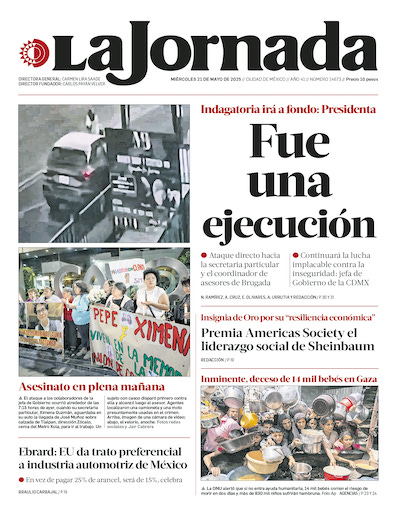
The double murders last week of Ximena Guzmán Cuevas and José Muñoz Vega, the former the personal secretary of and the latter a top adviser to Mexico City’s jefa del gobierno, have sent chilling shock waves through much of Mexico. The murders showed careful planning—the assassin had a clear sense of the scheduled route of the two victims, used an untraceable gun, had three cars for the escape. As I’m writing this, and this is one of the very surprising things about the murders, no one has claimed credit for the attack. Investigators know almost nothing.
Some see it as an attack on the jefa herself, Clara Brugada. A warning. The jefa del gobierno is a kind of high mayor of Mexico City—the largest city in North America—a city which by itself contains 7% of the population of the country. That becomes 20% if one includes the outer urban area—where many of those who work in the city live.
Some have wondered if the warning was actually aimed at la presidenta, Claudia Sheinbaum Pardo. A way of saying, look how easy it is to plan, murder, escape. We’re untouchable. The two women, extraordinarily popular, are also close political allies and good friends. The jefa del gobierno is probably the second most powerful elected politician in the country, second only to the president herself. Their Morena party, the party in power in all branches of the federal government, with majorities at the state and local level, is also highly popular, with the potential to mobilize large sectors of the population.
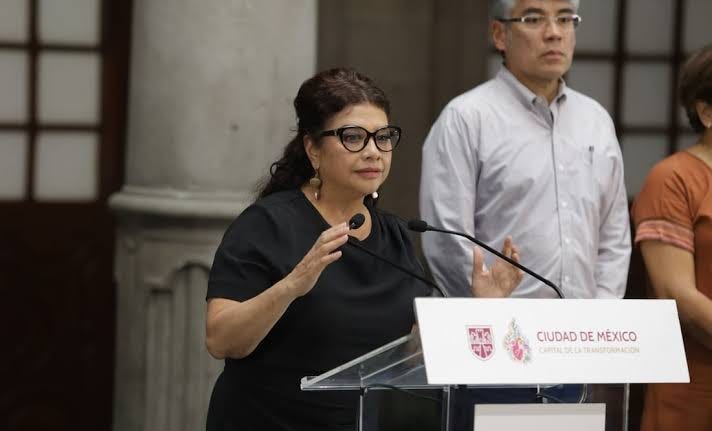
Clara Marina Brugada Molida, Jefa del Gobierno, Ciudad México
And the anonymity makes it even more mysterious, more sinister. It has caused speculation that has ignited fears in various sectors of the population. Of course, the biggest suspects are the country’s drug cartels. Is it one of them? All of them? Sending a message to leave them alone as they themselves seem currently engaged in their own struggles, with competing forces for leadership after some noted arrests and trials, in Mexico and the United States?
What makes it more shocking is that the two victims, Guzmán Cuevas and Muñoz Vega, were a part of the upper echelon of Mexico’s political elite, members of the jefa’s inner circle. They were well-liked, were known for their progressive politics, in particular around human rights. Shouldn’t these two, by the very nature of their positions, have been protected? They weren’t.
I love Mexico. I’ve loved it from the first day I set foot here, in March 1986. We moved here over 30 years later. I became a citizen. I love how I feel here, physically, emotionally, intellectually, spiritually. I breathe easier than in the US, I feel more alive.
And Mexico is a country of death. When we came in July 2016 looking for a house to rent for September, we got to know the brother of one of our New York friends. An American painter, he had lived here for a long time, married a Mexican. He said to us, This is a good place to come to die. I said to him something like, Oh, I think we’re coming to live. And he laughed and said, That’s what I mean.
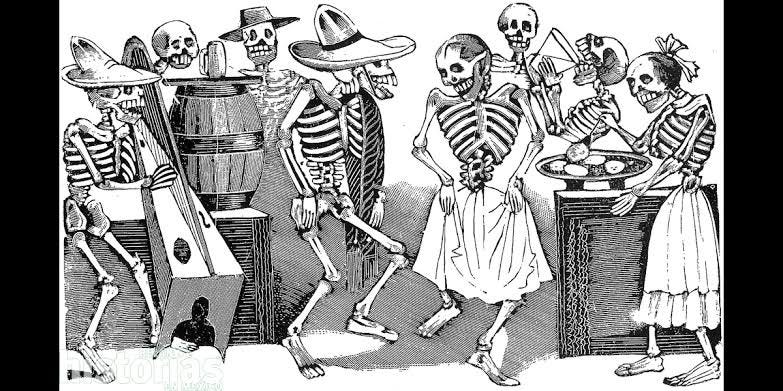
José Guadalupe Posada
When we get closer to El día de muertos, The Day of the Dead, I’ll no doubt have more to say on Mexico and death, on how death isn’t feared here but embraced. That death is part of the continuity of life. That those lines between life and death don’t have the same meaning as they do up north or at least that they’re blurred, because it’s just all one eternal, ephemeral dance.
Let it be enough to say for the moment that death in Mexico is present. Or better that it has a presence. Always. Not as a negative force. Nor as a positive one necessarily. Just a force. What happens after that? There’s the great elusive and constant puzzle.

Readers of Octavio Paz’s Labyrinth of Solitude won’t find this thinking on death unfamiliar territory. Nor will they find violence in Mexico unfamiliar. Those of us who live here know it well. It’s a part of the country’s history, centuries and centuries, before Spain, during Spain, after. It’s a part of the landscape, sometimes on the surface, sometimes buried deeply. It’s a part of all aspects of cultural life, daily life: in song, painting, poetry, dance, food, death is often close by. And just as close by? Life. As in joy. And happiness. As part of the same equation. Mexico is a country just as close to peace as it is to explosion. Peace and violence simmer together, wait for their moments. Unified. Separate. Yin/yang. Yang/yin.
So why did this violence, these murders, feel so different? The homocide rate here is high, but since 2019, it has been declining. Femicide rates are high, but those too are in decline, in part because there’s greater attention being paid now to the problem of femicide. Still, 9 in every 10 murdered here are men. And for the most part, those are gang related. They’ve been increasingly gang related.
Which might be what chilled so many? Because no gang has said we did it? Some estimates put gang control of the country, mainly in the north, as high as 30% and rising. Others say lower, declining.
If gang related, why these two people? And if not gang related, why these two (again)?
That’s part of the strangeness. Because, in a sense, it makes no sense. And that makes it feel very Mexican—a building and building and building to some kind of breaking point and someone decided that’s it, you die! And then not Mexican at all. Because it isn’t random, it’s planned and thought out. It has a purpose. Some purpose.
And no one yet knows what that purpose is. The when of the what is anyone’s guess. For now.
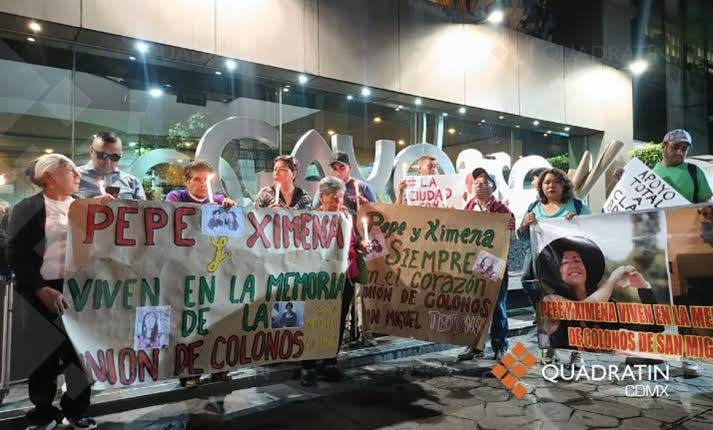
Mexicans turned out in force to mourn the deaths of Ximena Guzmán and José Muñoz.
A poet with great purpose is this week’s Poet in Mexico feature, my friend, Shira Dentz. Shira and I met for the first time, pre-Covid, at the New Orleans Poetry Festival. She had published a book with Lavender Ink/dialogos, the sun a blazing zero (2019), the same year as my first Mexico book of poems, Exile Home appeared. I thought Shira’s book was fantastic, and I asked Bill Lavender if she was going to be at the fest. She was. In fact, he suggested, we might even be reading together!
What struck me about Shira was her attention to a kind of emotional and physical imagery that, in many ways, reflects on some of the issues I reflect on above in Mexico—the ferocity of our emotions that expressed or hidden can’t ever be rejected or ignored. I had thought to write something really genius about her work but then Shira wrote me more about these poems. Readers of Marvel comics will be reminded of Stan Lee and “Nuff said.”.
These four poems come from my books spanning from my first to my most recent. What brings them together is their attention to visuality—fields of space. Each poem enacts vision not as static seeing, but as a shifting, kinetic perceptual labor.
In “Sisyphusina,” space carries weight—both literal and symbolic. Rocks, wind, vultures, even time itself drift across a gray, unstable terrain. It's a world that feels "immeasurably loaded." There are several poems titled “Sisyphusina” in my book titled Sisyphusina, centered on female aging, a subject without as much literary expression as male aging. I’m a firm believer in equal opportunity, including existentially, and since there isn’t a male Sisyphus, I created Sisyphusina.
This poem’s density stands in contrast to “spoke,” where the field is sparse and flickering. Here, movement interrupts form: spokes glint and vanish, and perception is a sudden spark—emdash and spoke combine both concretely and lyrically—in a nearly monochrome world.
“Blue Skies” turns upward, drawing from atmospheric vastness a chromatic time lapse that turns elegiac; the sky becomes a material to "use," "list," and ultimately grieve, even as its hues remain open and unmarred. A range of blues, from guttural to brilliant, pushes against and through grief’s occlusion. It’s a poem that came to me in NYC a few days after 9/11 when I noticed that the smell of burning shifted with the wind and the contrast of the clear blue sky with the horror of what had happened. It’s literally a poem that wrote itself through me.
Finally, “scale”—a concrete poem—plays with size and perspective— what we perceive is shaped by where we are. The visual field here can collapse or stretch, one at a time, echoing the magical elasticity of perception.
Across these poems, space isn’t just a backdrop. Dense or fleeting, mourned or measured, it’s always active, always reframing.
It’s my great pleasure to present these poems by my friend, Shira Dentz.
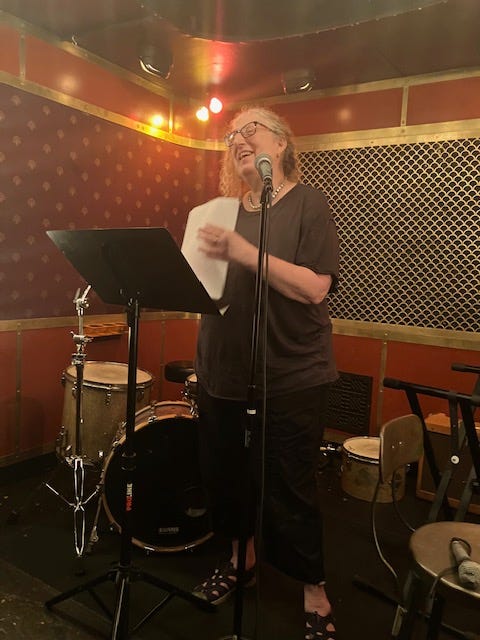
Shira Dentz, reading at Pete’s Candy Store, Brooklyn, NY, June 2024.
Sisyphusina (from Sisyphusina, from Astrophil Press, 2025)

So tired, rocks settling in back of my eyes. Bone
particles of sand + flat, smooth black rocks + a waterfall
= a Zen garden. But not calm. Immeasurably loaded.

Flat, smooth rocks and a waterfall. Black vultures fly so
high in southern Africa, tradition says they see the
future. Immeasurably & loaded like Dickinson’s gun. A
vista crawls through dugouts, or (depending on the
observer’s position) pillows, of gray static.

Vultures fly high. Want to sit this one out. Matter crawls
through pillows, gray. Listen to wind’s changing
seasons: winter wind, springwind, summer’s wind, fall.

I want to sit. Sleep the color of iron, pressing in-
between. Wind, a new season, paws at tree branches.
Vultures use gravity as a tool, dropping bones to the
ground to crack open their marrow.


Scale (from the sun a blazing zero, Lavender Ink/diálogos, 2019)
spoke (from blacks seeds on a white dish, Shearsman Books,  2010)

in the whirr of the tire
the spokes move so fast
you they

blend into one of the tones
on the gray scale
but not quite

once in a while a metal flash
a line—


Blue Skies (from black seeds on a white dish, Shearsman Books, 2010)

It’s a new sky today. I want to use this blue to make.
New, as we call the moon when it isn't visible,
but here, black smoke instead of the moon.

I want to take the blue like it’s something.
Today the most beautiful blue ever.
The fullest range of shades I want to list them.
Blue alone a rainbow.

On the third day, gone the smoke to breathe from,
gone the black funnel to a hovering
like a swarm;
a net, perhaps, of a yellowing black that makes me think of
someone dead, so, perhaps, the flag of corpse.

Today no interference.
You can keep looking up the blue.

Only across town the still-fresh smell,
guttural blue.

Good Links: Shira and Lila

Astrophil Books just republished Sisyphusina. Here’s the publisher, or (maybe better?) ask your favorite independent bookstore to order it. https://www.astrophilpress.com/titles/sisyphusina
To find out more about Shira, her books, readings, all that, check out her webpage. http://www.shiradentz.com/
Lila Downs, La Reina del Inframundo (Live), (2012):
The Oaxaca Grammy winner, singing about being queen of the underworld, fits very much with the dark humor and contradictions of death in Mexico.