
Communities, Consciousness, Poetry
And Poems from Paul Hoover

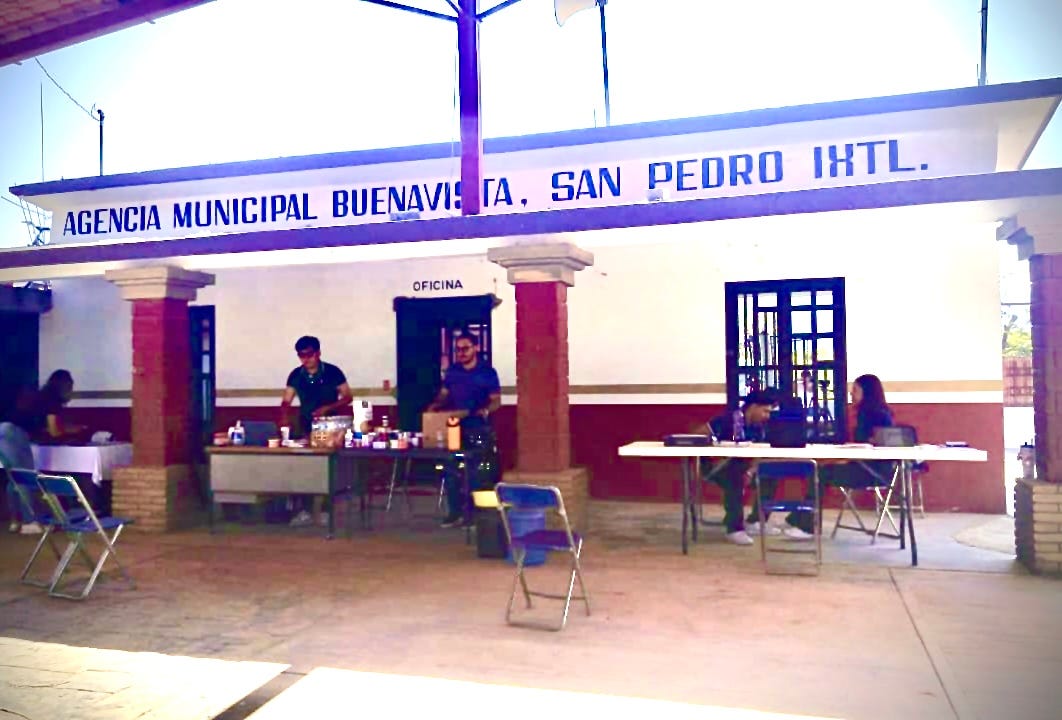
This past week in our colonia, neighbors setting up for free medical, dental, and ophthalmological checkups; there was also a setup for dogs and cats to receive veterinary care.
Lately I’ve been thinking a lot about community—and of the communities of which I’m a part. In the most immediate sense, there’s the small one of my colonia where our rancho is located in the larger pueblo of San Pedro Ixtlahuaca. I’ve written about the colonia before: we hold our asambleas fairly frequently, and they are where community decisions are made about the short and long term issues facing us. Often these are about water—many of the most pressing concerns in Mexico come back to water, the availability of it, the wasting of it. We’ve been dealing with questions around having a permanent health clinic that could serve not just our colonia but those around us as well. We deal with questions of safety. We talk about funding our small fiestas and how we want to contribute to the larger ones of our area (most notably larger San Pedro Ixtlahuaca itself). One discussion a few years back centered on having a colonia panteón (cemetery) though we realized relatively quickly that the obvious location for it would have placed it just uphill from our water supply. The idea of our water being nourished by the dead convinced us to drop the idea.
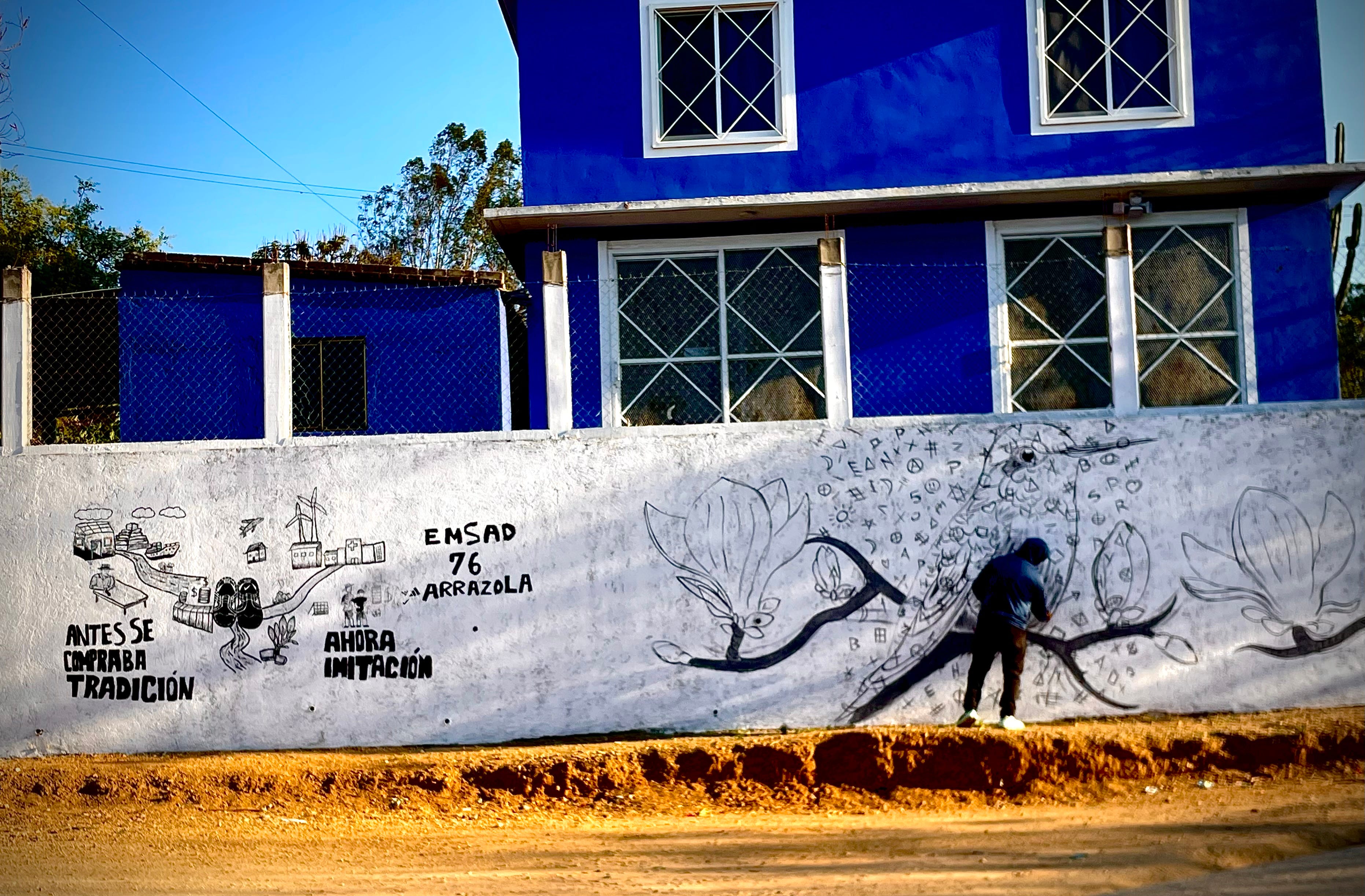
Mural under construction in our colonia, May 2026.
There are other immediate communities of which I feel part, to greater or lesser degrees. We have a strong block association on the privada where our house in town, one of eighteen, is located. Though I’m not a very active part of it, there is a small and vibrant English language community in Oaxaca centro. It’s a great resource for folks, especially those who move here from the US, and it is a real lifeline for those who want to stay connected with events in the US, especially around politics.
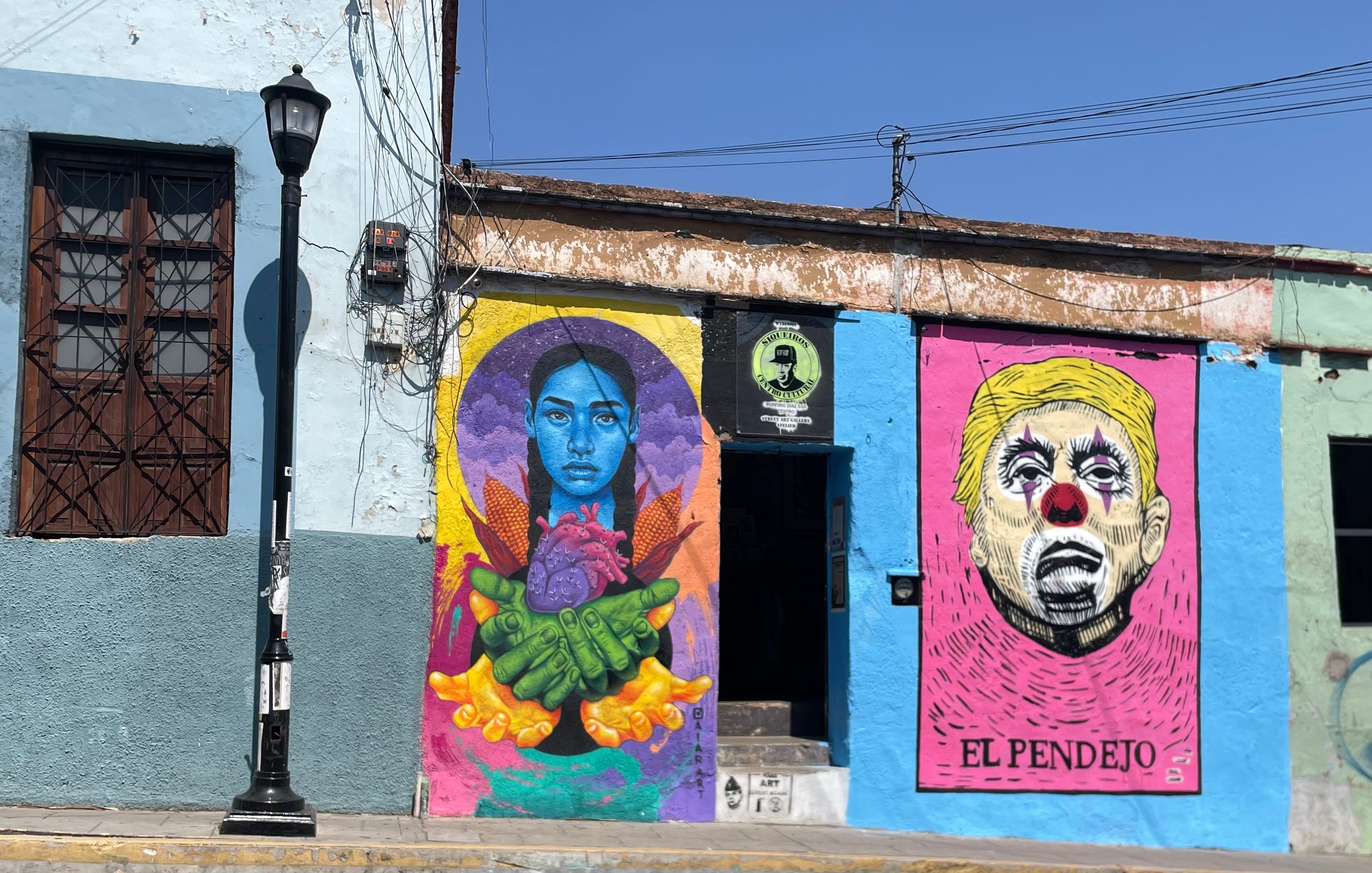
This mural in Oaxaca centro depicts two not uncommon themes in the city—local culture and political discourse.
Of course, as someone in recovery, I feel quite connected to the strong recovery community, and some of my closer friends come from that group. As a naturalized Mexican, I’m finding myself more and more able to identify as Mexican (mexicano gringo, some of my Mexican friends will note) and that feels both a little weird and very satisfying. And I remain very much a US citizen, with all the pride and (current) embarrassment that comes with that.
In the last few years, I’ve also come to understand the importance of the different, often overlapping, literary communities of which I’m part. There’s the vibrant one here. In the last months or so, with the publication of my translation of Araceli Mancilla Zayas’ House of Ciervo, and the English language version by Efraín Velasco and me of his Spanish text Scenes Left Out Of […], my sense of belonging to the literary community has deepened greatly. We’ve done readings together from those books and for the New Orleans Poetry Festival we made the film The World in Red and Black, directed by Cannonball Statman—which also featured the Zapotec poet Pergentino José Ruiz. I have given readings over the years here, in bookstores, libraries, museums, galleries, and participated in literary festivals here and elsewhere in Mexico. At our rancho, we hold occasional music, poetry, and art events, featuring both local and visiting artists—the poetry is usually in Spanish, English, and original languages. I have to admit, though, it’s only been in the last three or four years that I find myself more and more able to see myself as a part of the Oaxaca and Mexican literary communities. Which is as it should be. To become a member of any community ought to take time.
The World in Red and Black (2026), New Orleans Poetry Festival cut.
In a certain way, I do still identify with literary communities in the United States, most notably in New York where I lived for most of my life. I’ve been back in the US a number of times over the years to read from new books, to see family and friends, though since the onslaught of Covid there have been fewer northern trips. In the almost ten years, since Katherine and I have moved to Mexico, the connections have become a little harder to maintain. Distance will do that, as will daily life. It’s one of the reasons that this Poet in Mexico substack has taken on real importance for me. It’s a way to have greater contact with my friends in the US, to write and talk with them, to publish their work. It’s also given me a chance to introduce some of my friends up north to some of the Mexican poets I’ve come to know and admire. I was recently looking through the poets and poems I’ve had the chance to publish in Poet in Mexico in the last almost year-and-a half since I started the substack. I have to say, it feels like some kind of honor roll. If you are new to reading Poet in Mexico, I invite you to go through the archives and read the poetry there. And if you aren’t new, I invite you to go back anyway and be amazed perhaps (as I was), by the wonderful work.
Some Poems:
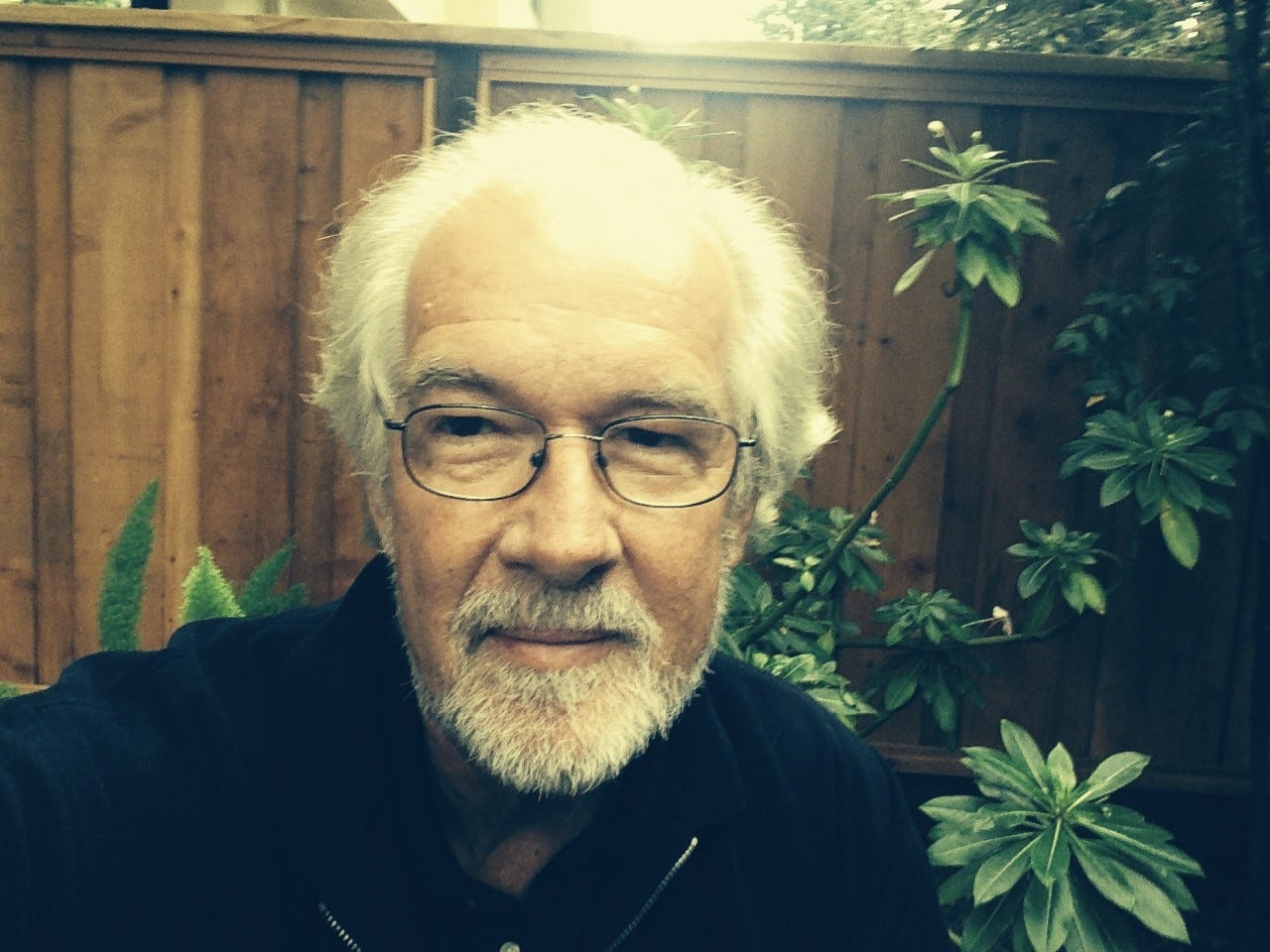
All this brings me to today’s featured poet, Paul Hoover. Paul, who has written novels, translated a number of poets (including Friedrich Hölderlin, Maria Baranda, as well as poetry from the Vietnamese), is best known (by me) as a poet. He has written 16 books of them, won awards, and is generally just one of the more important poets out there.
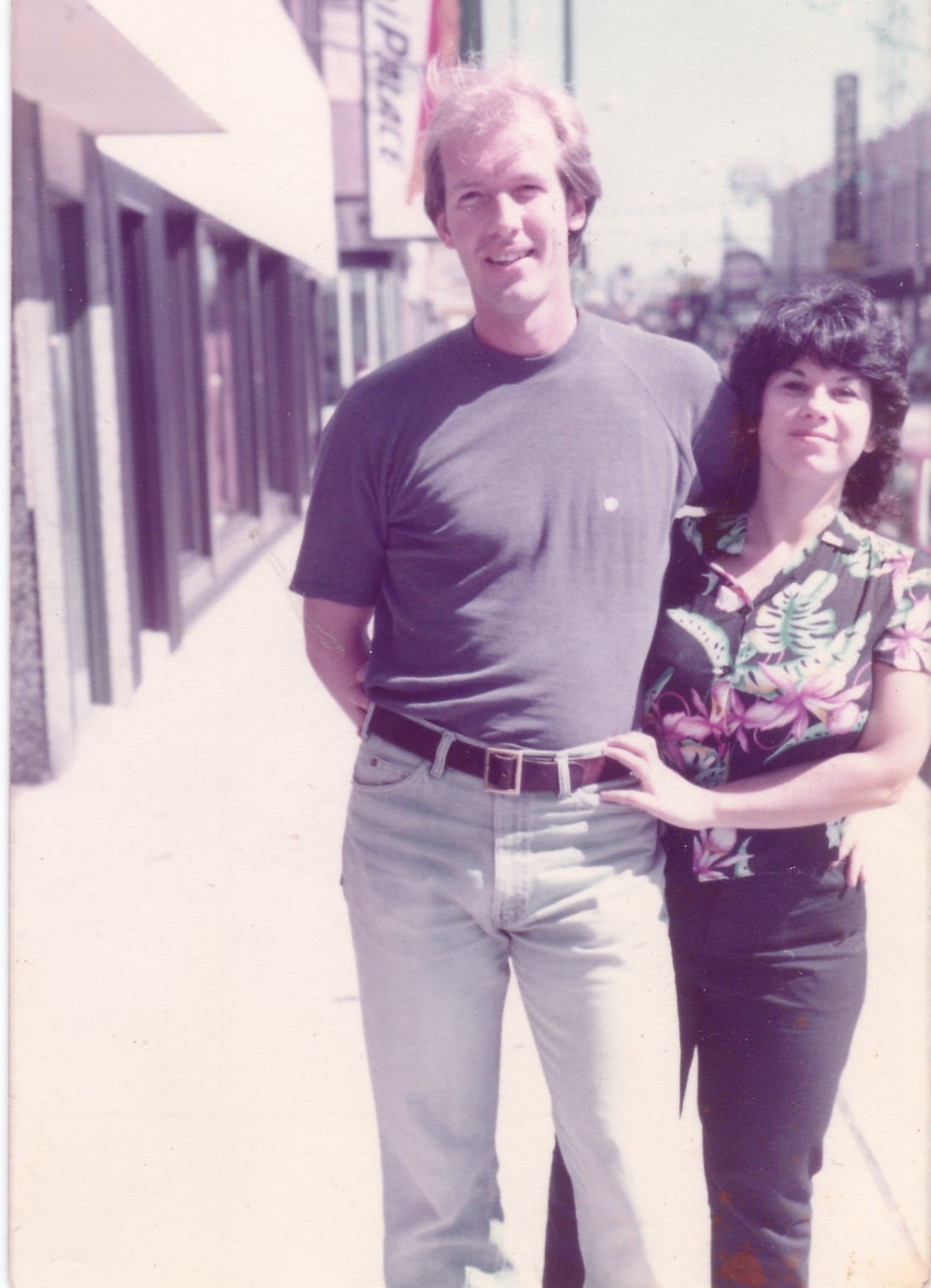
Paul Hoover and Maxine Chernoff, 1982.
Paul for many years, along with Maxine Chernoff, was more legend to me than someone I actually knew, because for the longest time I didn’t know him. But Paul and Maxine were legends. In the 1970’s Paul was living in Chicago—he had moved there after graduating from college, worked in a hospital as part of his service as a conscientious objector to the war in Vietnam. Along with two other poets (Dean Faulwell and James Leonard) he founded Oink! magazine. When Faulwell and Leonard left, Maxine, who had joined the staff earlier, became coeditor. By the time I had become aware of Oink!—it was when I was an undergraduate in the late 70’s, the magazine was already a must-read for any poet. This was despite it coming out of Chicago, because in those heady days, many of us in NYC weren’t really sure poetry was being written anywhere else. The list of contributors is a who’s who of American (and world) poetry. Eventually Oink! became New American Writing, which comes out annually. Paul will publish issue number 44 of NAW in August 2026. Paul and Maxine eventually moved to the Bay Area in the mid-2000’s, where Paul still lives and teaches poetry at San Francisco State University.
I first met Paul in real life at the annual PEN America awards ceremony in NYC in 2015 (I think it was that year). I had been one of the judges for one of the translation prizes and Paul was also attending. Katherine remembers it was our friend, the poet Sharon Mesmer, who introduced us to each other at the event. Paul mentioned to me (as he shouldn’t have, but that’s one of the great things that makes Paul Paul) that he had been reading my work because he was serving on a review committee for me at the college I taught at. He was enthusiastic. We met up a little later at the American Literary Translators Association (ALTA) annual meeting where Paul heard me read from my translations of Martín Barea Mattos’ Never Made in America, which diálogos would publish in 2017. Paul asked me if I would send him some of these for NAW.
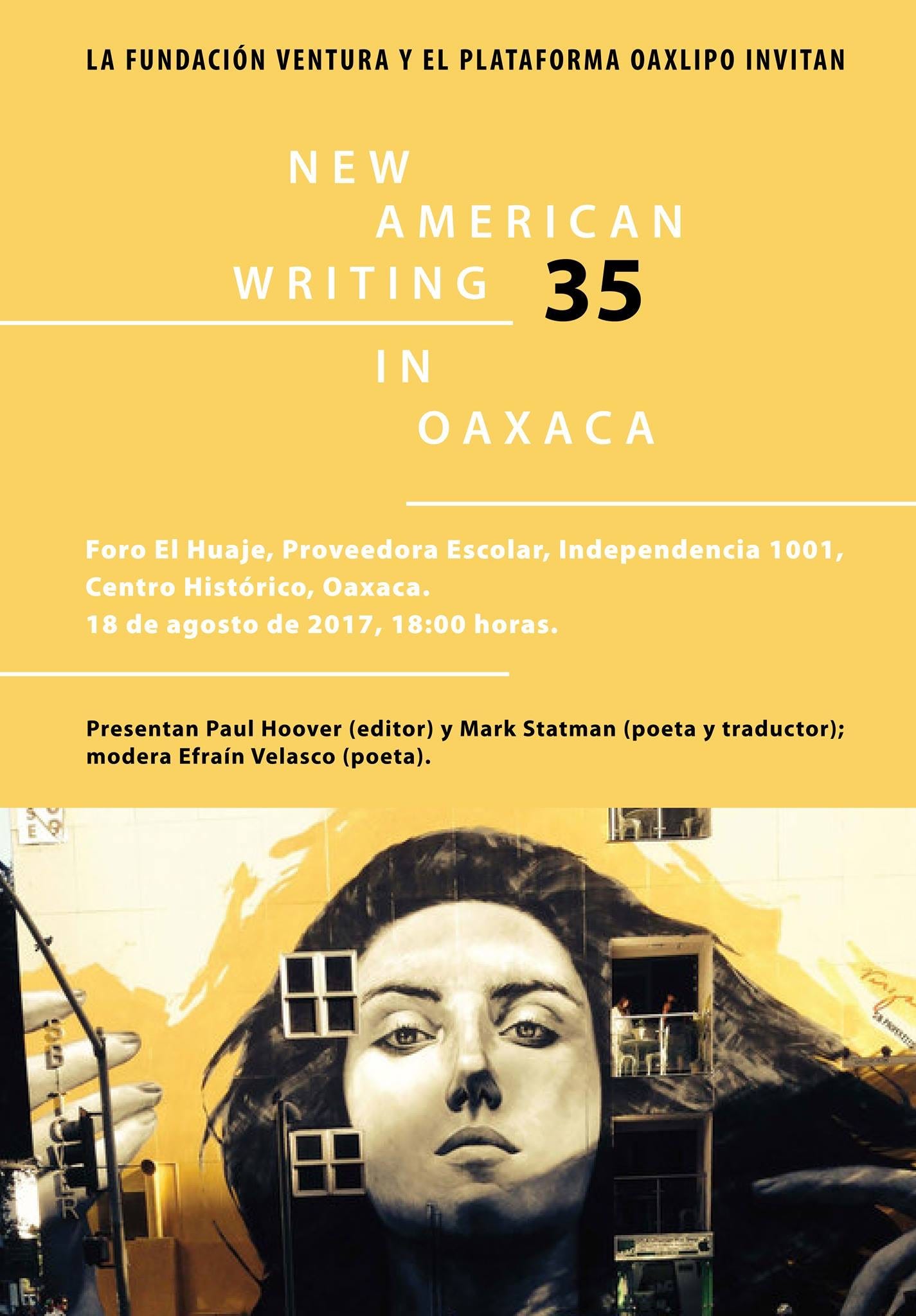
When New American Writing 35 appeared in 2017 with those translations, Katherine and I had already moved to Mexico. Efraín Velasco, who was even then one of my closest friends down here, was intrigued and wondered if I didn’t want to do an evening/reading built around those translations and other poems in the issue. We would hold it at the Proveedora Escolar bookstore, one of the cool places to read in Oaxaca. I wrote Paul and asked him if he could send me 15-20 issues, I’d pay, that we could give away as part of the event. Paul wrote me back and wondered if he couldn’t just bring them down and deliver them himself!
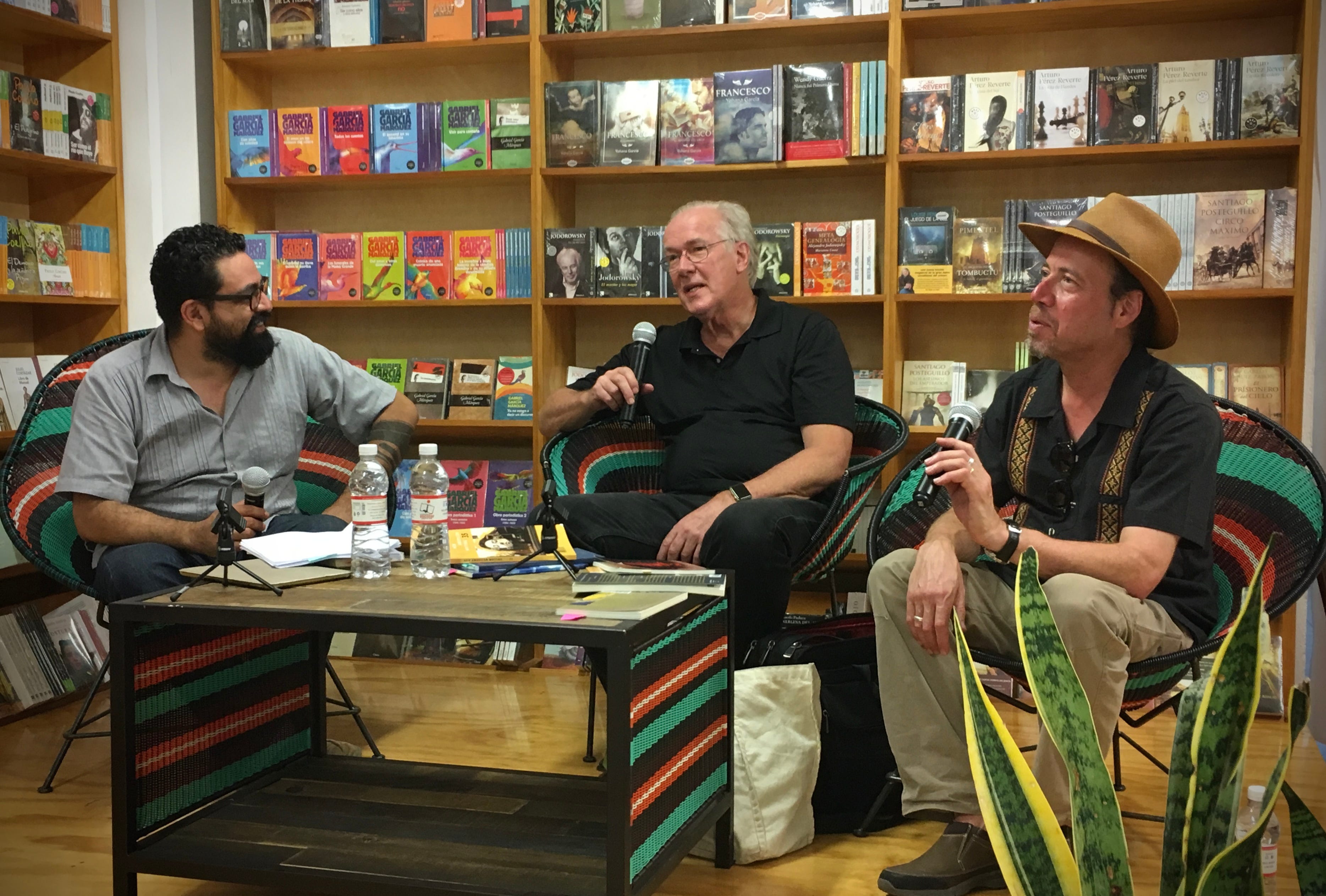
Reading and talking about poetry with Paul and Efraín at Proveedora Escolar.
And he did. It turned into a marvelous event. We read from the issue, Paul, Efraín, and I read new poems as well, and we had a terrific discussion, with a lot of audience involvement about poetry in the United States and Mexico. Of course we had a fun dinner afterwards. Paul stayed in Oaxaca for a few more days. We went to a party. We went to Monte Albán and to the Sunday sprawling outdoor market in Tlacolula de Matamoros (the oldest active market in the western hemisphere). And, as these things happen, I got Paul to the airport late, about half an hour before his flight for Mexico City was to leave. The pilot had just closed the plane door and there was nothing to be done. No entry. Paul (graciously) didn’t hold it against me. There’d be another flight in an hour.
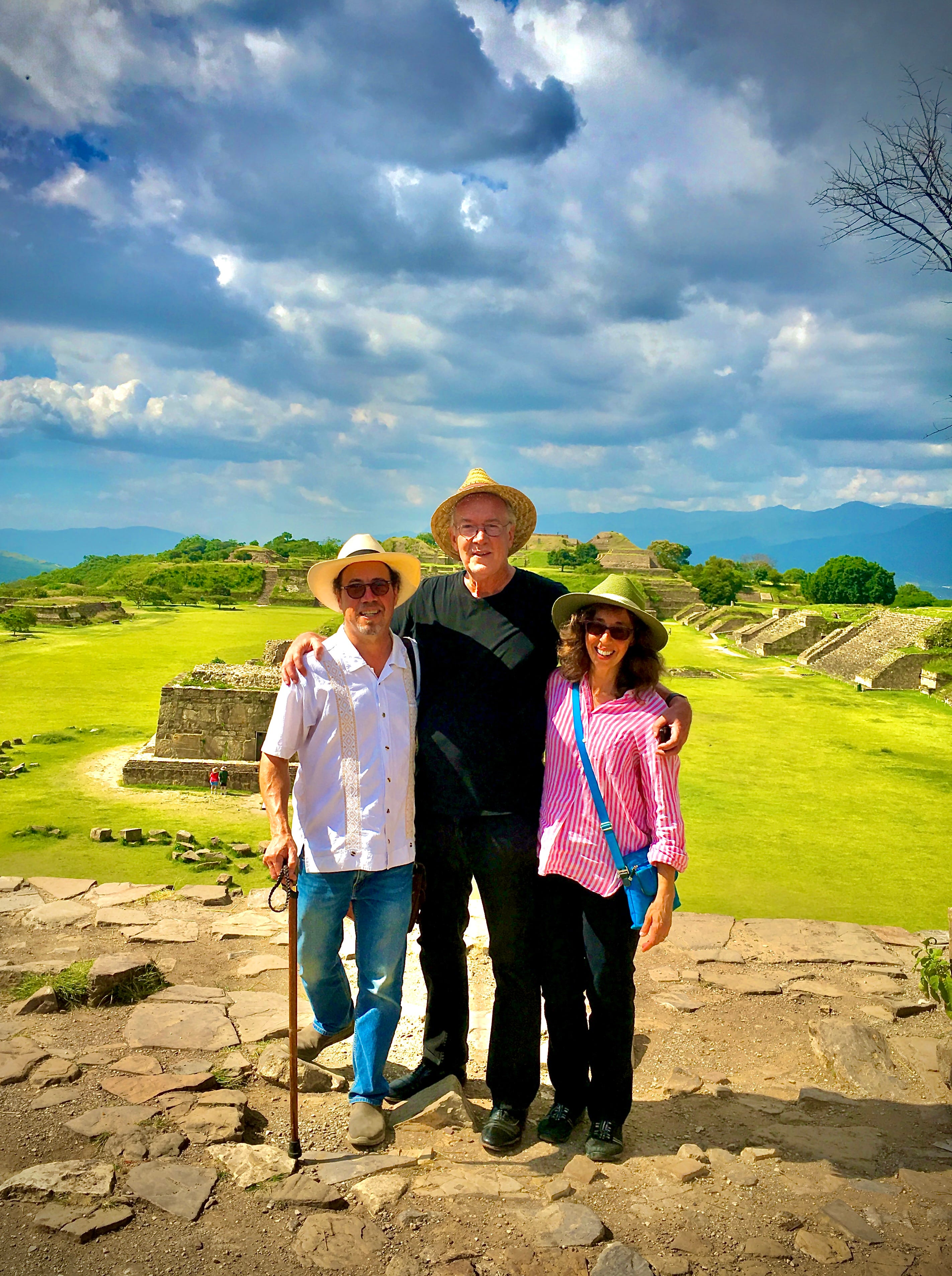
With Paul and Katherine at the ruin at Monte Álban. Yes, he’s pretty tall…
I’ve had a chance to write with Paul over the years and to see him as well. He has generously published my poems and translations in more than a few other issues of New American Writing. We had a lovely dinner together the last time I was in the Bay Area in 2019. Maxine and I were reading together—I also had the chance that trip to read with one of my oldest and closest friends Joseph Lease, who has also been featured in Poet in Mexico—and as I remember all this and write these names, it reminds me of the pleasure and meaning of that literary community.
Which brings me to a last thought. I think, in a sense, if you are reading this, you are a part of another growing community, in which discussions of poetry, love, and social justice in my two great neighboring nations come together. Yes. So, for this post, please help me welcome my friend, Paul Hoover, to Poet in Mexico.
Four Poems from Paul Hoover

Libretto

Insistently, in the evening, a book is singing to you,
pushing you gently along the cliff-edge of sleep, until clouds brighten
a tablet abandoned near the foundry, near a river of molten steel,
creating the gray sculptural shapes of a father who punishes when he blesses.

In admiration of itself, the restless aptitude of mirrors
carries you within, where the image of mother cries to no one
in the heartless parlors of West Virginia, with thunderstorms passing
and guns in the narrow hallway, the glistening rain her master.

Perhaps now it’s acceptable for the husband to crash over fields
in his fat black car, allegro.  The clamor
of hysterical men is within us, their motors run
too loudly in the vestibule of sleep, they drive like children into the future.


Dwelling

You dwell at green lights
longer than expected.
Thoughts that had gone far
are slow in returning.

You pause before a panel
of highly reflective metal
and stay there, half in love.

A thousand dwellings,
all of them strange:
dripping of a faucet,
yawning of a cat.
On your way to the bathroom,
the squeaking of bats.

Reason is persuaded
by peaches and cream.
Anything held to a mirror
makes you want to dwell.

The moustache and the pipe,
so dreamlike in appearance.
You have to live a while
to understand such things.
The squirrel with its teeth,
grackle with yellow eyes,
used to be familiar.
You must be dwelling.
Horseman, pass by.

The dream surrounds us
with the grace of the strange.
Snow falls sideways,
and the owl flies so low
it’s mirrored in the pond.
The trees are covered
with sleeves of ice
after a winter rain, crazed
with light and the shattering
of their crystal.  This too is
dwelling, the thing in its
richness, a kind of winter mind.


The Fish

The goldfish swims in its bowl
near a window facing the street.
It’s 1959 and Peggy Lee’s “Fever”
passes through the open window.
It’s two in the afternoon forever.

Perhaps the fish can see the street
with its slow-moving cars,
the man smoking Chesterfields
on his way to church,
and the prim little boy walking
with a white mouse in his hand,
a gift from his maiden aunt.

Circling in its bowl, it seems to see
the giant standing in the room,
wearing the bluest dress her mother could find.

Perhaps the fish is coming up with a theory
relating to one and zero,
unity and difference.
But no, it only swims and eats,
with no concept of escape or recreation.

It’s got it good, in its way,
the way we got it good,
our clothes pressed for school,
father released from jail
and working again in his shed.

The world also goes in a circle,
tilting away from the sun.
It’s out there looking for something
but comes back every year
with little for the finding.

Time, too, goes in circles,
on watches only the old people wear,
the ones who think they’re short on time
and go to the bank for conversation.


“The One Who Will Come Has Come”

-Ghassan Zaqtan

The rain has rained, and the storm has stormed
over the tiendas and used car lots,
coursing into the rivers and oceans; in thunder
and sonorous calm, they have come and gone.

In Tlaquepaque, the old men who sang
“Sabor a mi” and “Contigo”
have returned to thoughts of their wives,
as if they were still alive.
They smoke a bowl and lie down for a nap
that could last the rest of their lives.

The one who will come has come.
She speaks of the new sadness, sadder than the old,
She knows of a new realism, richer and deeper
than the one we are living.

She signs you up for the new sleep
and the new risk-taking,
but it’s an ancient lovemaking
that arrives once a week.

Like the mouth of a woman thinking
the most uncomfortable things,
like a word meeting the object
to which it most belongs,
the one who will come has come.

Rivers pass, clouds pass,
and the rumble of cars is eternal
on the street where your family lives.
A mountain passes as only a mountain can,
so slowly you’d think it was still.
Hours turning into weeks,
these also pass, quite pleasantly it seems,
and later, the hours we no longer have.
Good Links: Paul Hoover and Linda Oaxaca
Paul Hoover, O, and Green: New and Selected Poems (Mad Hat, 2021)
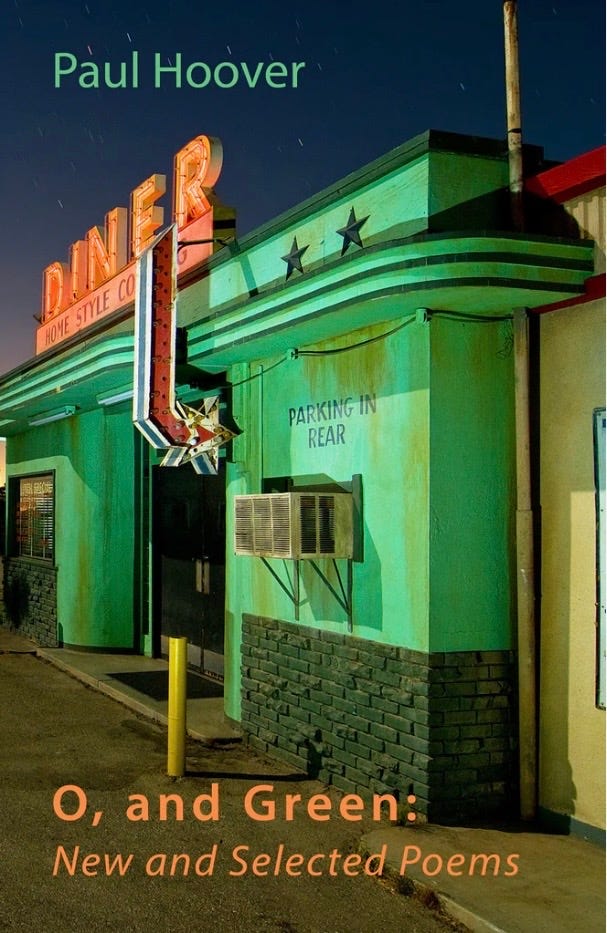
Readers of Poet in Mexico know what comes here. While this book is available from online dealers (including the publisher), even greater is to go to your local, independent bookstore and order a copy for yourself and ask them to get a couple of copies for the poetry section. Support independent bookstores! And independent literary presses! https://madhat-press.com/products/o-and-green-by-paul-hoover?_pos=1&_sid=5921dc504&_ss=r
Linda Oaxaca, Patricia Lujano y Grupo Bohemio
A lovely version of this song. Some nice photos as well!
Please comment! Please share! Restack! Respond!
Follow me on BlueSky: markstatman.bsky.social
Ditto! “Linda Oaxaca” video especially beautuful. Thanks Mark!
Mark,
What a wonderful post!
Excelente explanation about communities, pretty pictures (I wonder who the pendejo is), and my favorite poem is The Fish.
Adelante!