
Christmas Jew
Ornaments on the cactus and radish nights in Oaxaca

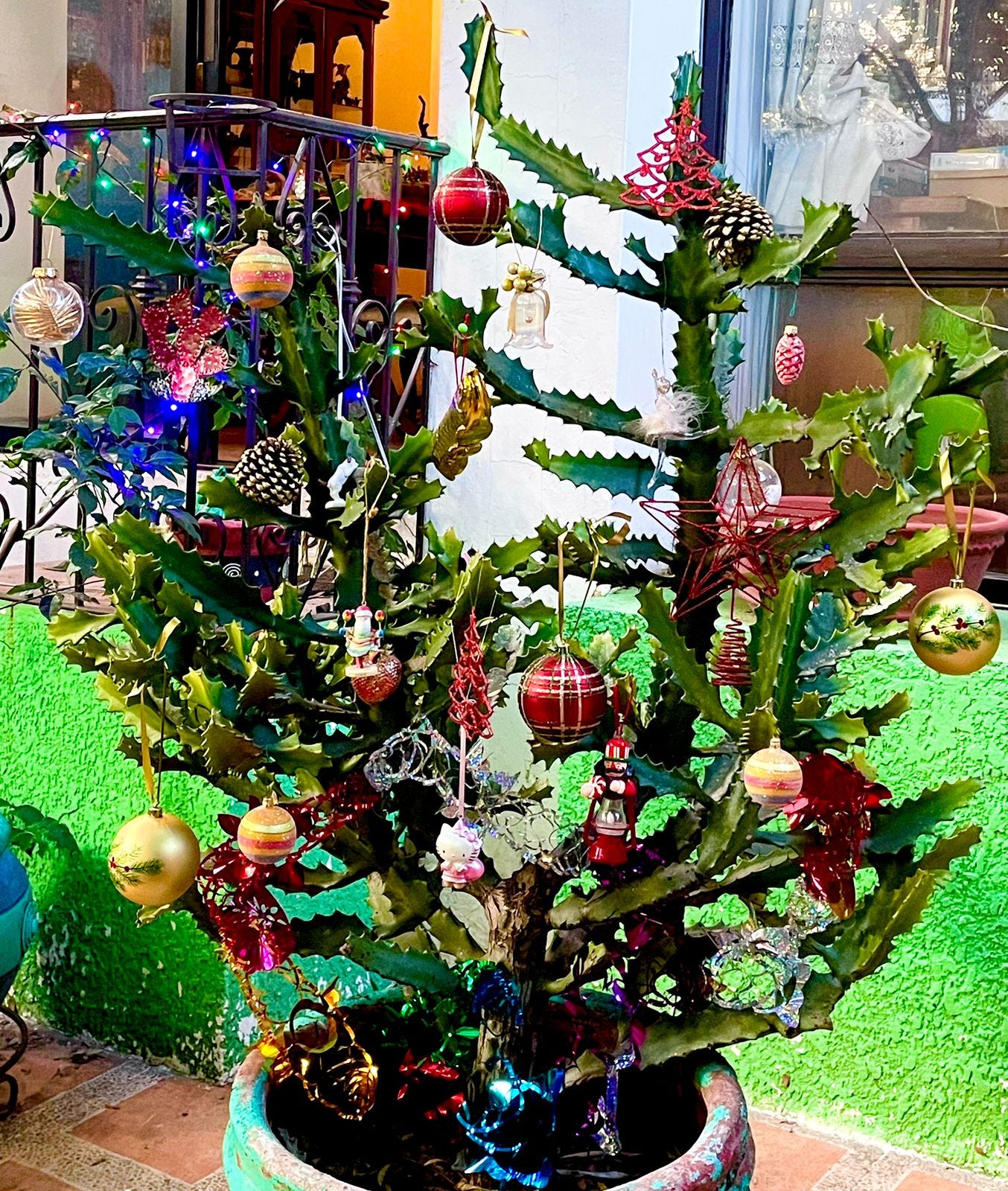
Our Christmas Cactus.
fiesta mortal

one kiss could
take hold of the
soul could send
us spinning off
the cliffs the masks
disguises we carry
on our bodies
tattooed with
equal signs and
parentheses hammered
silver copper we
own the world
because of love
because illusion
small beds of the
past boats on the
rise the kiss
changes winter a
fall and embrace of
knowledge eyes
that light up when
you enter the
room a boomerang
so many things
we never thought
and here they
are figures in
columns addition
subtraction I count
syllables sometimes
other times words I
listen for rhymes
at the end of the
day and how
love with love is
lined up

—Mark Statman, from Hechizo (Lavender Ink, 2022)
At some point, long before our move to Mexico in 2016, I posted a photo on social media of our Christmas tree. My friend, the novelist and essayist Lisa Solod responded: I thought you were Jewish?
Some folks wondered to me if Lisa was being aggressive. I answered that I didn’t think she was at all. I thought she was asking me an important question. Because I am Jewish. My faith matters to me. A lot. Though it’s true that the way I understand Judaism is a little outside of the mainstream. I find myself most closely singing in the process theology Judaism choir. And I’m grateful I can say that my faith informs my principles in all my affairs.
So, while it can be a little difficult in southern Mexico to even think about any kind of regular in-person synagogue attendance, being a Jew has continued to define a lot of who I am as poet, (retired) professor, activist, husband, father, brother, son, friend, human being. It richly informs my aesthetics and my ethics, my politics, my thoughts and actions. Obviously it’s essential to my spiritual life. It’s a part of how I understand what I wrote about last week in thinking about gratitude: Keatsian soul-making.
When I was in high school (shout out to the Commack High School North class of 1976—fifty years ago this June we graduated!), I had the good fortune to take a senior year elective class on world religions, taught by Jane Kramer. I had no idea then what that would mean to me. The class was inspiring, giving me ways of thinking about faith and practice that were unexpected and deep. In Ms. Kramer’s class, among other things, we read William James’ Varieties of Religious Experience, which was (still is) quite eye opening for me. I would go on, as an undergraduate at Columbia to major in Comparative Religions, a precursor to my even deeper interest in religious studies. I knew early in school that my commitment was to poetry. I also could see how immersing myself in this other study, as an academic and as a believer, would matter to me as someone committed to love, social justice, and beauty.
All that thinking back then gave me a respect for difference and mystery. It opened me up to the meanings behind greatness and smallness, to the challenges posed by knowledge, silence, and commitment.
(Interestingly enough, for me, is that the work in Comparative Religons, gave me the opportunity to take courses in Indian and Chinese theology/literature with, among others, two of the foremost translators in the field, Barbara Stoler Miller and Burton Watson; working with them inspired my senior thesis, a translation and analysis of the hymns of Martin Luther—back then my German was pretty good—which eventually led me to see how serious creative translation could be. Of my 16 books, 6 are of poetry in translation).
If, as Antonio Machado writes, Hacemos el camino por andar/ We make the road by walking, I found my paths crossing and crossing again the paths of so many others. It has been an extraordinarily powerful journey.
As for the Christmas tree? Katherine grew up a Quaker. She celebrated Christmas. Even before we got married, I started celebrating it with her. And I really loved how she and her extended family also celebrated. In most ways, it was pretty secular. Great food. Drink. Great conversation. Gift giving. A lot of laughing and a lot of closeness. Eventually, many of us had kids, and the chance to watch their joy in celebrating the holiday together was considerable.
I loved thinking idiosyncratically about Christmas. I was an outsider who felt welcomed. My favorite part happened to be the tree. There was something wonderful about having it indoors, how it would make home smell of pine. I loved conventional ornaments as well as weird ones. When we moved to Mexico, in place of a tree, we decided to switch over to our Christmas cactus (see again photo above). It’s different, with the same silly spirit.
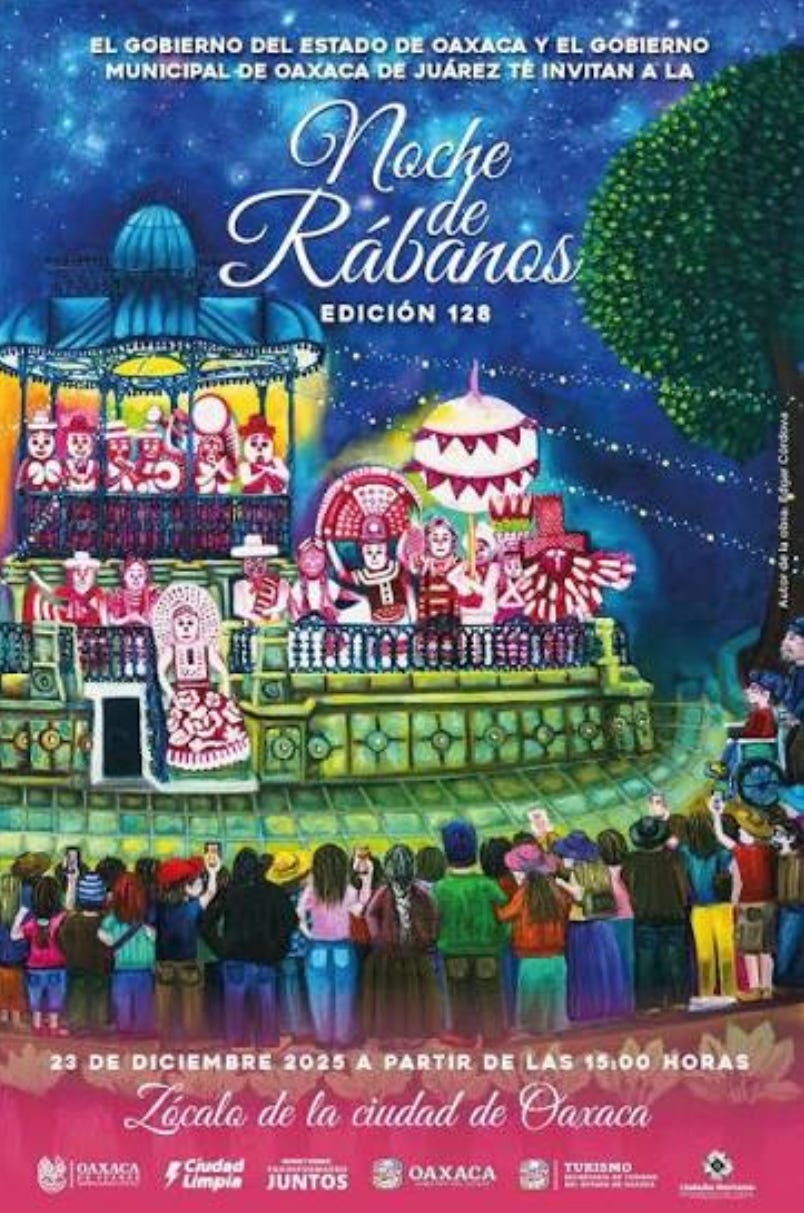
The most celebratory days of Christmas in Mexico are Christmas Eve and Three Kings Day. In Oaxaca, in addition to those, there’s December 23, the Noche de Rabanos. On the Zócalo, there’s a giant fest and display of sculptures made out of, yes, radishes. Artists come from all over the state to display their artwork and the crowds are enormous,with folks lining up for hours ahead of time to have a view. I encourage you to do a search for images for the Noche de Rabanos in Oaxaca. You won’t be disappointed.
Of course, there were too many Christmases in the past that had too much sturm und drang. In which I was a principal actor. And cause of too much unnecessary harmful drama. In recovery, there’s less, though memory always has a voice in the present no matter the best intentions. We’ve found it best in recent years to make any Christmas celebration lower key, less stressful. And? More loving.
So how not to celebrate Christmas? As a Jew, thinking about the beauty of it is easy and welcome. How not to want to celebrate a life that stands for love and tolerance, for caring for the sick and needy, that represents commitment to equality, compassion, hope? Who doesn’t want to take a moment, given the state and situations of this world, to dream one in which peace, good will, and kindness guide us?
So this: It’s been a little less than a year since I started this Poet in Mexico project—my first actual post was January 14 of 2025. The support I’ve received for it, from readers and contributing poets, has been astonishing and inspiring. A gift beyond measure. As this year closes out, looking forward to the next one, I wish all of you serenity, tranquility, and joy. May your days be full of love.
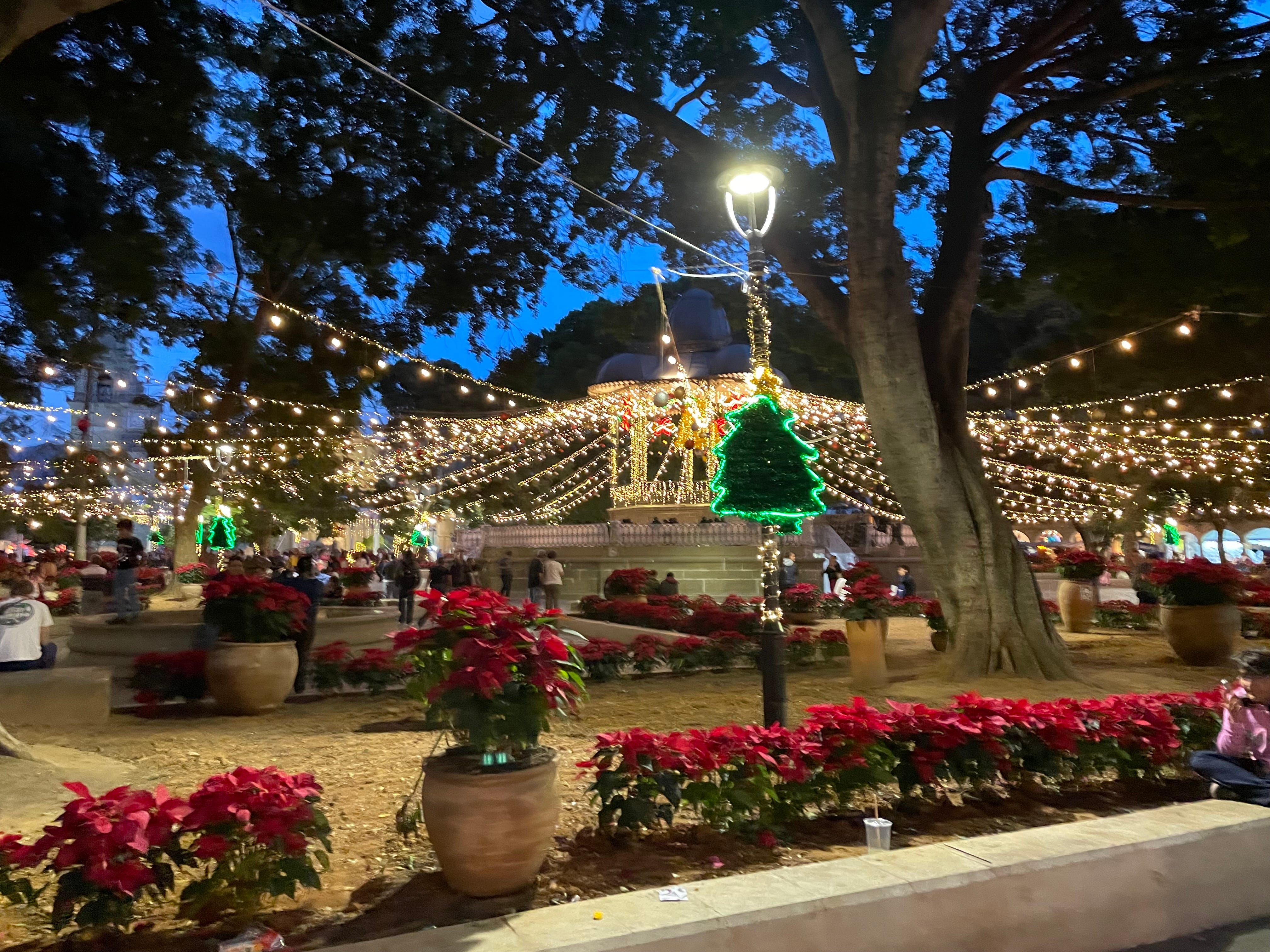
Oaxaca Zócalo, December at night..
every hour a life

what you say what
I say says something
always never
said our hearts like
mirrors looking glass
fate and the fates
know more each
passing second they
grow threads in
their teeth threads
in the clouds a
galaxy threaded with
meteor storms and
sacred constellations how

will it happen
language of sound
distance radiance
a thoroughfare of thorough-
breds every act of
contrition an act
the fates draw in
concentric circles
arcs of stones like
the stones we threw
thrown to ocean
thrown to sky earthly
mornings clove copal
rosemary honey
the field cleared
the well in the middle
brims with brackish
life-saving water

I have a memory of
your eyes melodies
chained the rest
of the night
hands over hands
we slide into beds like
birth like death then
the end of the
picture we know
what happened
thieves and fates
in the trees every-
day I say perdón I
mean it like a prayer
meant to be heard
we’re in on the
secret a surprise
morning light

—Mark Statman, from Volverse/Volver (Lavender Ink, 2025)
Good Links: Three of my favorite Christmas songs: John and Yoko, Judy, and José
John Lennon, Yoko Ono, the Plastic Ono Band, Happy Xmas (War Is Over)
Why does this song feel so relevant for me right now?
Judy Garland, Have Yourself a Merry Little Christmas, from Meet Me in St Louis
This movie, which came out in 1944, has so much in it. And this scene so much to love. Through the years, if the fates allow.
José Feliciano, Feliz Navidad
In the late 1980’s, in early December, I was teaching poetry to kids in a school in the South Bronx, and I arrived early to one of the second grade classes I regularly taught. The second graders were seated in their seats. Their teacher in the front of the room. had just handed out a sheet of paper and the teacher was explaining to them that this was a song they were going to sing for their parents. He took them through the words in Spanish (many of the kids didn’t know them) and then the words in English. He then quietly sang for them the song. Then he asked them to join in. They (very) quietly sang along with him in Spanish and then, without any prompting, as soon as they got to the English, two girls jumped up out their seats and started bopping around and singing I want to wish you a merry Christmas. Suddenly, all the kids were up and clapping. Singing. The teacher sat there, surprised. He turned to me. Smiled. I think they know the song.
An indelible image in my brain.
Feliz Noche Buena! I especially appreciate this post because we are often in Oaxaca for the holiday season. But just want to add that the line from Machado is “Se hace camino al andar” (which I know, in part, because it’s tattooed on my arm).
Buon Natale, Mark! This is beautiful (as always)!